





How to Change Habits and Break Out of Autopilot

Have you ever decided to change a habit, only to find yourself doing exactly the same thing again without really thinking about it?
Perhaps you automatically reach for your phone when you wake up, put off going for a walk or fall back into a familiar routine despite genuinely intending to do something differently.
Learning how to change habits starts with understanding why this happens.
A surprising amount of our everyday behaviour happens automatically. This is useful because it allows the brain to conserve attention for things that require more thought. But it can also make changing established patterns more difficult than simply deciding to behave differently.
Understanding how habits work can help you recognise those automatic patterns and create more opportunities to make conscious choices.
Why So Much of Our Behaviour Is Automatic
Research by psychologist Wendy Wood and colleagues found that around 43% of the behaviours they recorded were habitual, meaning they were repeated in the same context, often without conscious attention.
There is a good reason for this. Automating repeated behaviours makes everyday life more efficient and frees up mental resources for things that need more of our attention.
The difficulty comes when we want to change something.
The brain doesn’t categorise a habit as helpful or unhelpful before repeating it. Familiar situations can simply trigger familiar responses. That means even a habit you genuinely want to change can continue almost automatically.
Why Changing a Habit Can Feel So Difficult
When you set an intention and then find yourself doing exactly what you always do, it can be tempting to see it as a lack of discipline.
But conscious decision-making is only one influence on our behaviour.
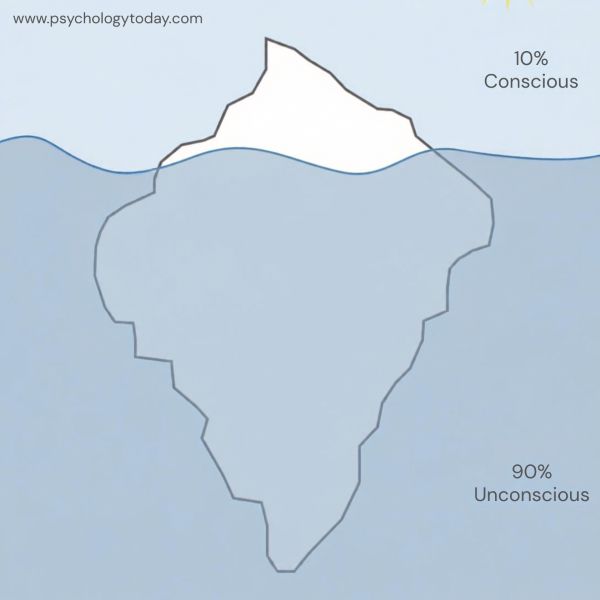
Psychologists sometimes use the image of an iceberg to illustrate this. Above the waterline are the intentions, choices and decisions we are consciously aware of. Below it are automatic patterns, assumptions and learned responses that can influence what we do before we have consciously considered it.
This doesn’t mean you have no control over your behaviour. It means that changing an established pattern usually requires more than setting a broad goal.
First, you need to notice the pattern.
Awareness Can Help Interrupt Automatic Habits
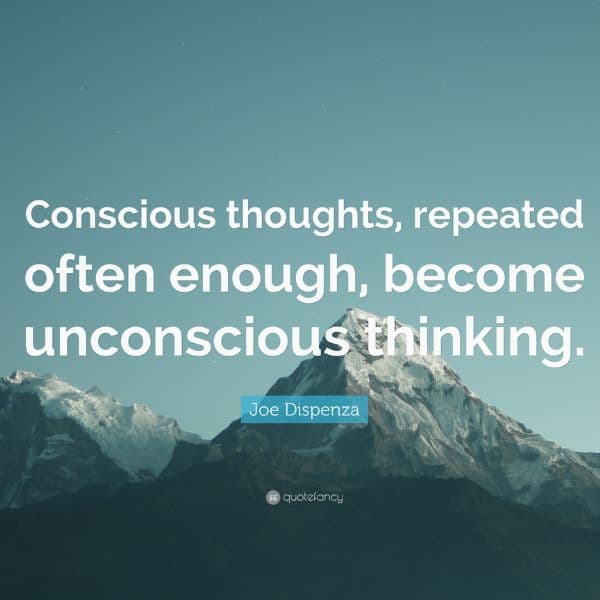
Dr Joe Dispenza argues that thoughts, feelings and behaviours can become familiar patterns that repeat from one day to the next.
Cognitive psychology also describes a negativity bias, where negative information can have a stronger effect on us than comparable positive information. Worry, self-criticism and pessimistic thoughts can therefore become part of our mental background without us necessarily noticing them.
Becoming aware of a pattern creates an opportunity to respond differently.
You can experiment with this yourself. Spend a few minutes paying attention to your thoughts. When you notice a negative or unhelpful thought arising, pause before automatically following it. You don’t have to force yourself to think positively. Simply notice what is happening and consider whether there is another way to respond.
The aim is to practise noticing the pattern rather than automatically following it.
From Automatic Thoughts to Automatic Actions

The same principle can be applied to physical habits.
Imagine that reaching for your phone is the first thing you normally do when you wake up. Instead of trying to transform your entire morning routine overnight, start by pausing before you pick it up.
That small pause interrupts the automatic sequence and gives you an opportunity to make a conscious choice.
You might still decide to pick up your phone. The important difference is that you have noticed what you were about to do rather than simply following the familiar pattern.
Repeated over time, moments like these can help create space for different behaviours to develop.
How To Support More Conscious Decision-Making
Our brains rely on familiar patterns partly because they make everyday life more efficient. Interrupting those patterns can therefore become harder when we are tired, stressed or constantly overstimulated.
This is why the basics matter alongside your mindset.
- Quality sleep plays an important role in learning and memory.
- Regular movement supports physical health and brain health.
- Time away from screens and constant stimulation can give you more space to slow down and notice how you are spending your time.
You can also look at your environment. If a new behaviour requires several extra steps while an old habit is effortless, the familiar behaviour has an obvious advantage.
Making the behaviour you want to encourage easier and more accessible can help remove some of that friction.
Grounding, Relaxation and Mental Wellbeing

Some people also choose to include grounding as part of a routine designed to create periods of calm and reduced stimulation.
A 2024 review published in the Medical Research Archives discusses research investigating grounding and changes in brain activity measured using techniques including EEG and neuroimaging. The authors suggest that grounding may influence processes associated with relaxation, rumination and cognitive function.
Research into grounding is still developing, so these findings should be considered as part of an emerging body of evidence rather than proof that grounding itself will change a person’s habits.
However, grounding can also be approached more simply: as an intentional activity that gives you an opportunity to stop, reduce distractions and pay attention to the present moment.
Making a New Habit Easier to Maintain

If grounding itself is a habit you would like to develop, the same principles apply.
Going outside barefoot is one way to make direct contact with the Earth, but weather, location and everyday routines can make that impractical. Reducing those practical barriers may make the behaviour easier to repeat consistently.
For people who want to ground indoors, our range of indoor grounding products includes grounding exercise mats, fitted sheets, bands and patches. If you prefer to ground while spending time outside, a grounding shoe strap can provide another option while walking.
Whichever habits you want to develop, lasting change doesn’t have to begin with a dramatic overhaul of your life.
Start by noticing what you already do automatically. Create a pause. Make the alternative easier to choose.
Small, intentional choices, repeated consistently, can gradually become familiar patterns of their own.
Grounding is a simple practice with growing scientific interest. Whether you’re exploring its potential benefits for sleep, stress, inflammation or overall wellbeing, understanding how it works is the first step.
You can explore our full range of grounding products and research resources to see what may suit your routine.